
RRSP vs. TFSA: Which Account Should You Max Out First for Early Retirement?

The eternal Canadian dilemma: Should you contribute to your RRSP or your TFSA first? If your goal is early retirement, the answer depends heavily on your current income bracket, your expected income in retirement, and your overarching FIRE strategy.
Understanding the Mechanics
Before we can determine which is better, we need to completely understand how the Canada Revenue Agency (CRA) treats these two accounts.
The RRSP: Tax-Deferred Growth
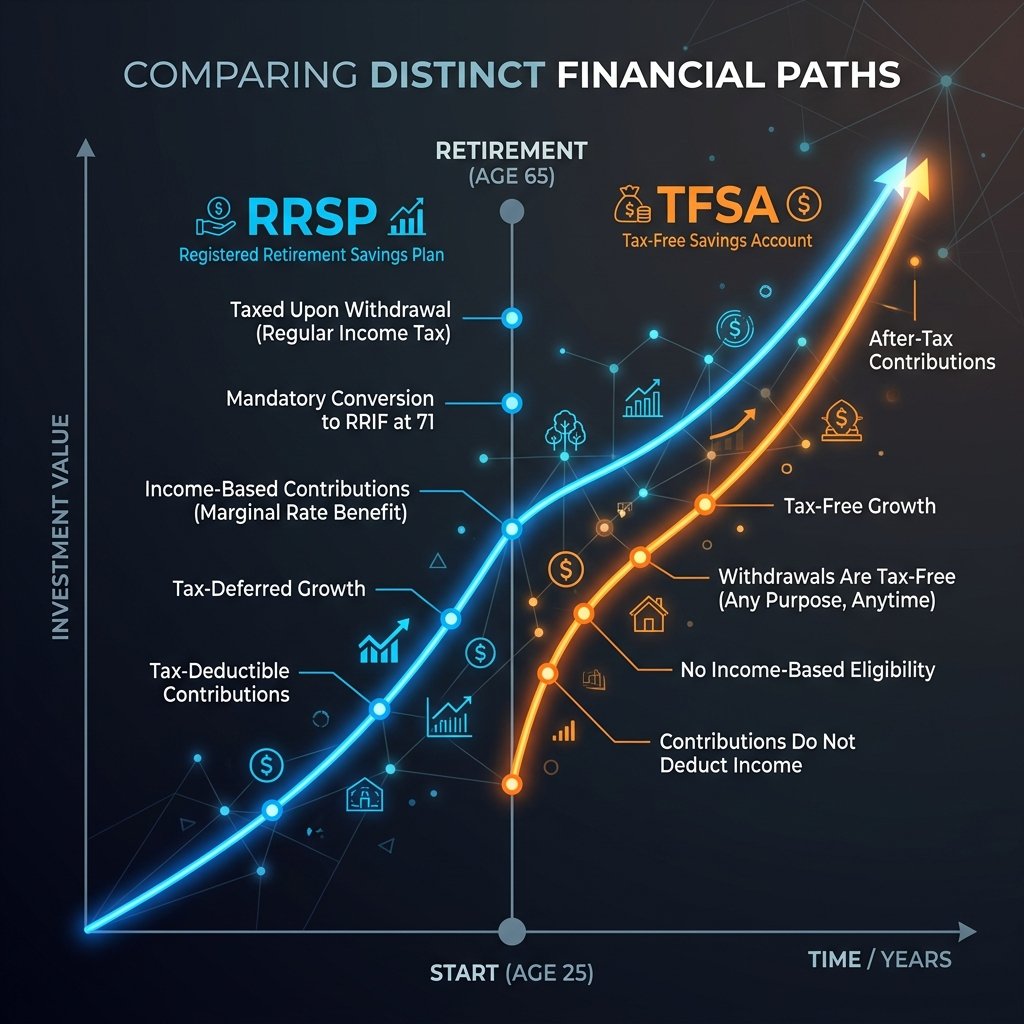
The Registered Retirement Savings Plan (RRSP) is a tax-deferral vehicle. When you contribute money to an RRSP, you deduct that amount from your taxable income for the year. This almost always results in a tax refund.
- The Catch: The government isn’t giving you free money. They are giving you a loan. When you withdraw the money in retirement, every single dollar is taxed as ordinary income.
- The Benefit: If you contribute while you are in a high tax bracket (e.g., earning $120,000) and withdraw when you are in a low tax bracket (e.g., earning $30,000 in early retirement), you permanently avoid paying the difference in tax rates.
The TFSA: Tax-Free Growth
The Tax-Free Savings Account (TFSA) is horribly named—it should be called a Tax-Free Investment Account. You contribute with after-tax money (meaning you get no tax refund today).
- The Catch: You don’t get immediate gratification on your tax return.
- The Benefit: All growth (dividends, interest, capital gains) is entirely tax-free. When you withdraw the money, it is not considered income. It is invisible to the CRA and will not trigger clawbacks on government benefits.
The Math: Which Wins?
Mathematically, if your tax rate at contribution is the exact same as your tax rate at withdrawal, the RRSP and TFSA yield the exact same final after-tax amount (assuming you reinvested the RRSP tax refund). Therefore, the decision hinges entirely on marginal tax rates.
Scenario A: The High Earner ($100,000+ income)
If you are in a high marginal tax bracket (e.g., 43% in Ontario), the RRSP is usually the clear winner. You get a massive 43% return on your contribution via the tax refund. If you retire early and have zero earned income, you can withdraw that RRSP money in the lowest tax bracket (paying ~20% or less). You just created a 23% permanent wealth advantage.
Verdict for High Earners: Max the RRSP first, reinvest the refund into the TFSA.
Scenario B: The Low/Middle Earner (Under $60,000 income)
If you are in the lowest tax brackets, an RRSP contribution provides a very small tax refund (e.g., 20%). When you retire, you will likely still be in that same 20% bracket, or perhaps even higher if you have a generous pension or massive CPP payouts. Furthermore, RRSP withdrawals count as income, which could cause you to lose low-income government benefits like the GIS.
Verdict for Lower Earners: Max the TFSA completely before touching the RRSP.
The FIRE Specific Strategy
For those pursuing Financial Independence Retire Early (FIRE), the TFSA has a massive hidden benefit: Flexibility.
If you retire at 40, you cannot touch your RRSP without paying immediate withholding taxes (and permanently losing that contribution room). The TFSA, however, can be accessed at any time, for any reason, with zero tax consequences. You also regain the contribution room the following calendar year.
Most successful FIRE practitioners use a hybrid approach:
- Contribute enough to the RRSP to drop down one tax bracket.
- Put all remaining savings into the TFSA.
- In early retirement (ages 40-60), live off a mix of non-registered dividends and TFSA withdrawals.
- Slowly “melt down” the RRSP by withdrawing just enough to stay in the lowest possible tax bracket, transferring that money to the TFSA if it isn’t needed for living expenses.
Conclusion
There is no one-size-fits-all answer. You must calculate your current marginal tax rate and estimate your retirement tax rate. Use our calculators to model both scenarios and see which path leads to your FIRE number faster.

Written by
A passionate financial educator dedicated to helping people understand the mechanics of early retirement, tax optimization, and long-term investing.
View all posts by →